Technical specifications
The MS2 receiver is a compact GNSS system suitable for every application that needs precise ground positioning.
The product has the following general features:
- it is Made in Italy
- it is affordable
- it suits every kind of user
- it carries the CE marking
- it is extremely simple to use
- it is compatible with any Android device, and soon with iOS
- it uses the plain-text NMEA format or the proprietary binary one
- it comes with an up-to-date guide
- advanced technical support, for both software and hardware
The technical specifications of the MS2 GNSS receiver are listed below:
GNSS chip
- Internal 184-channel engine
- Satellites tracked:
- GPS L1C/A, L2C
- GLO L1OF, L2OF
- GAL E1B/C, E5b
- BDS B1I, B2I
- QZSS L1C/A, L2C
- SBAS
- RTK update rate up to 20 Hz
- RTK position accuracy 0.01 m + 1 ppm CEP
- RTK convergence time < 10 s
- Cold acquisition about 24 s
- Aided starts 2 s, reacquisition 2 s
- Sensitivity: tracking and navigation –167 dBm
- Cold starts –148 dBm, hot starts –157 dBm
- Reacquisition –160 dBm
- Operating temperature -20°C to 60°C
- Storage temperature -30°C to 70°C
Connections
- Interfaces: - USB-C - I2C (SDA, SCL) - (on request) - SPI - (on request) - UART1 (Tx & Rx) - UART2 (Tx & Rx) - (on request)
- Data stream:
- SMA connector for an external GNSS antenna (on request)
- 2 TTL UART ports, 1 I2C port, 1 USB port, 1 SPI (on request)
- RAW data available over USB, I2C and UART (Tx, Rx) - (on request)
- PPS pin (on request)
- 8 GB flash memory (not included) for raw data logging (on request)
- Corrections in and out over the interfaces:
- TCP (on request)
- LoRa (on request)
- Bluetooth
- RS-232 (on request)
- NTRIP in RTCM3 format
- Quectel 4G modem (optional)
- LoRa TX/RX radio, frequency range 868/915 MHz, up to 8 km in open field (optional)
- IMU sensor (optional)
- Bluetooth v4.0 - 2.4 GHz class II: up to 50 m – SPP, DUN, PAN, GATT
- Wi-Fi IEEE 802.11a/b/g/n
Antenna and phase centre
- Active multi-band Amotech antenna (L1C/A, L2C, L1OF, L2OF, E1B/C, E5b, B1I, B2I) supporting the GPS, GLONASS, Galileo and BeiDou constellations for high-precision applications, with a built-in low-noise amplifier with 29 dB gain and a 0.9 dB noise figure.
Note
GNSS measurements refer to the so-called phase centre of the antenna. The position of the antenna phase centre is not necessarily the geometric centre of the antenna. In fact it is not constant, but depends on the direction the radio signal comes from.
The phase centre is defined as the apparent source of radiation. An ideal source would have a spherical equiphase contour, but the real case is slightly different, because the equiphase contour is irregular and each segment has its own apparent origin of radiation. The phase centre of an antenna therefore depends not only on the angle (elevation and azimuth) but also on the frequency of the signal.
The diagram below shows the offsets from the base of the receiver (5/8 threaded mount) to the two phase centres:
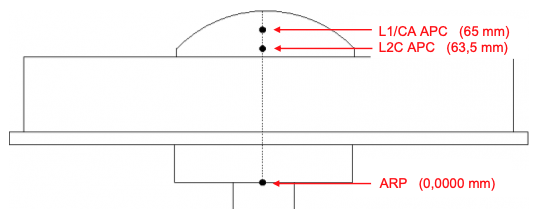
Fig.1 Diagram of the antenna phase centre with the offsets from the base
Output
- Output formats:
- CMR
- CMR+
- RTCM 2.1
- RTCM 2.3
- RTCM 3.0
- RTCM 3.1
- Navigation output with NMEA-0183 support (GGA, GSV, RMC, VHD, GSA, ZDA, VTG, GST)
- NTRIP network protocol (VRS, FKP, MAC, IMAX and NEA supported)
Power supply and consumption
- High-capacity 4000 mAh lithium battery, 3.7 V
- Consumption about 350 mAh with Bluetooth connected and data being exchanged
- Battery life about 11.5 hours in RTK mode (4000/350)
- Estimated charging times from a completely flat battery:
- about 5.5 hours when powered over USB-C (fast charging - 720 mAh)
Dimensions and weight
The chassis of the MS2 receiver has the following dimensions and weight:
- length 100 mm
- width 100 mm
- height 52 mm
- weight 464 g